
One AI Pipeline for Every Data Source, Not One Box per Analytic
Legacy AI deployments dedicate compute to each analytic and leave data siloed. MIDL's agnostic AI pipeline lets you orchestrate MIDL models, your own models, and third-party models on one shared infrastructure.
Most organizations do not have a data shortage. They have a data activation problem. Cameras, integrated business systems, dispatch records, and devices produce signals every second, yet each source tends to live in its own tool, with its own alerts and its own dedicated AI hardware. We believe that model is the real bottleneck, and that the way forward is a data platform that treats every source as an input to one shared AI pipeline.
Why one box per analytic no longer works
The traditional way to enable a detection is to gather a large set of images, train a model for one particular object or activity, such as weapons, and then deploy it. In the legacy approach, each of those analytic solutions arrives with its own AI compute. Every new use case means another model, another stack to run, and another place where results are trapped. The people who need answers end up working across disconnected systems.
MIDL still trains models in this traditional way when it makes sense. What sets us apart is a more efficient training method that gives us a much wider range of detections than others can offer. But breadth of detection is only half of the story. The other half is where those models run and how their output connects to everything else you care about.
An agnostic AI pipeline on shared infrastructure
MIDL is built as an agnostic AI pipeline. Customers can use our AI harness to orchestrate their own models or third-party models alongside MIDL models, all on one shared set of AI infrastructure. Instead of deploying AI compute per analytic solution, you bring the models you need to a common foundation and let the harness coordinate them.
That shift changes the conversation. A model you built in-house, a specialized model from a third-party vendor, and a MIDL detection are no longer separate projects with separate hardware. They are components in the same pipeline, producing data that can be combined, compared, and acted on together. You choose the best model for each job without rebuilding the plumbing each time.
From any input to any action with the mission builder
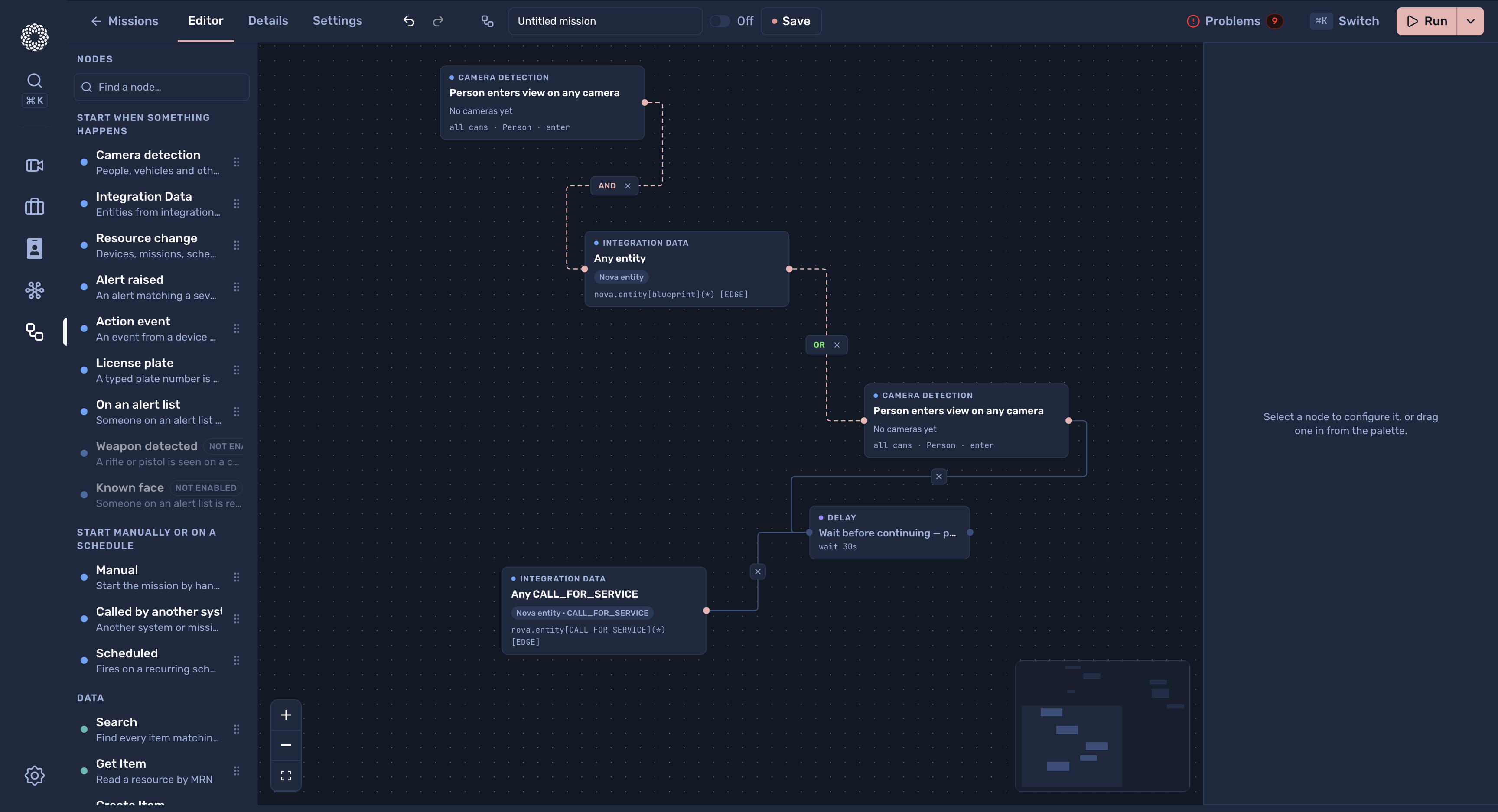
The mission builder is where the platform becomes tangible. It is a visual canvas where you use any system as an input, run any transforms and analysis you need, and then trigger any digital or physical action as the output. The node library in our builder shows how broad the starting points can be.
Triggers that span data sources
A mission can start when something happens. The available triggers include camera detection, integration data (entities from connected systems), resource change, alert raised, action event, license plate, and on an alert list. Missions can also start manually, be called by another system or mission, or fire on a recurring schedule. Camera detection is one trigger among many, which is exactly the point: video is one data source in a platform, not the whole platform.
Logic, timing, and data lookups
Between trigger and action, the builder gives you the tools to reason across sources. AND and OR connectors combine conditions, a Delay node waits before continuing, and data nodes such as Search (find every item matching a query) and Get Item (read a resource by its MRN) pull in additional context. These are the building blocks for alerting across data sources rather than inside one.
A mission example from the canvas
The mission shown in our builder screenshot illustrates the idea. It starts with a camera detection for a person entering view on any camera, joins that through an AND connector with integration data for any entity, and then an OR connector brings in a second person-enters-view detection. Separately, integration data for a CALL_FOR_SERVICE entity feeds into a Delay node set to wait 30 seconds. Camera events and records from an integrated system sit in the same flow, governed by the same logic.
The mission builder lets you use any system as an input, run any transforms and analysis, and output any digital or physical action. Cameras are one source among many.
Data you can use, and a platform that keeps improving
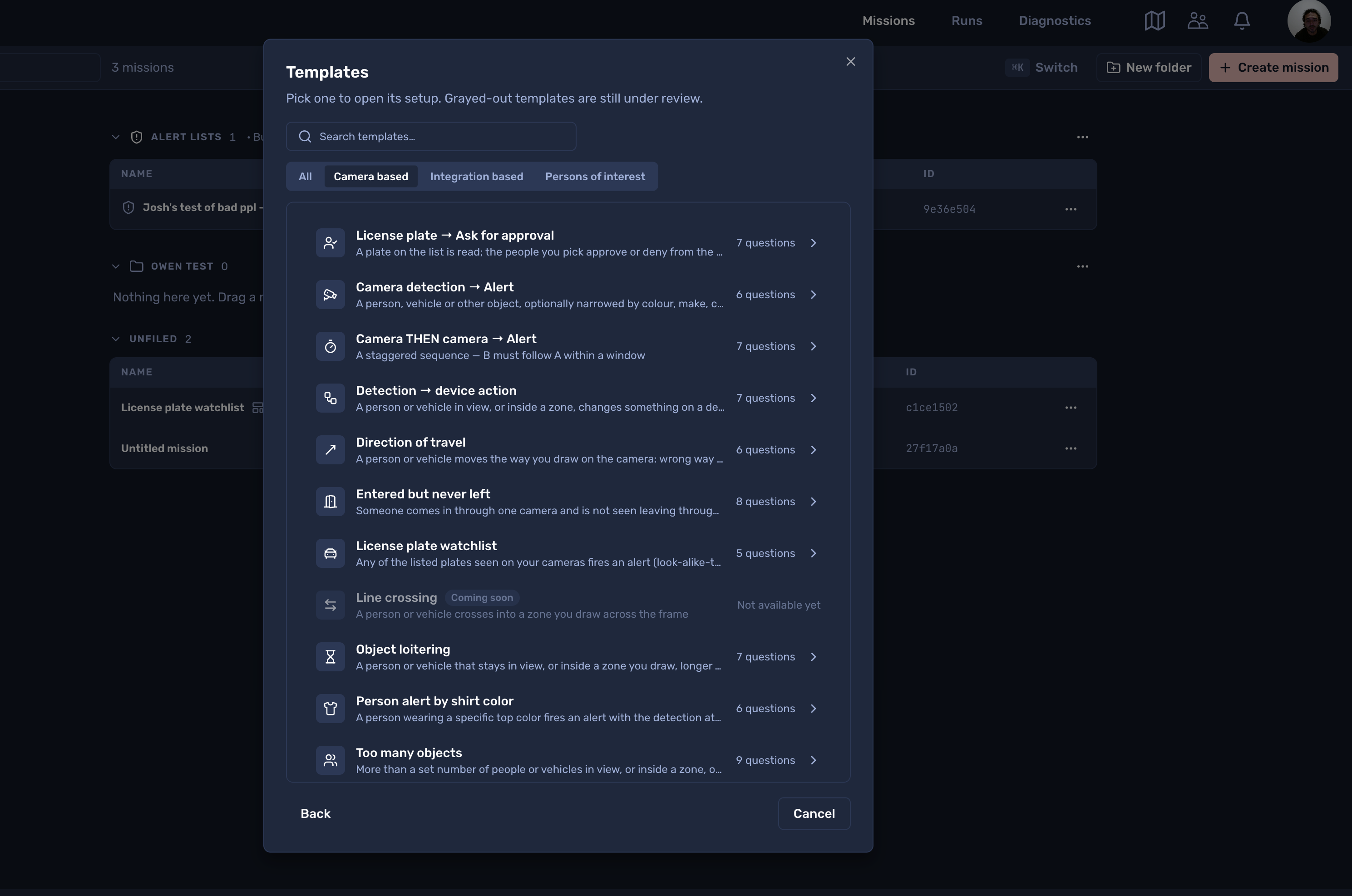
MIDL is, at its core, a search platform for your data. Our software continually searches the streams and sources you connect for the activity you care about. When something you want to be alerted for is detected, you and/or the appropriate responders receive a notification. All other activity is cataloged so you can surface it instantly whenever you like. You tell MIDL what you are looking for by typing or speaking to it.
Our strength lies in detecting a wide range of objects and activity and then presenting that data in a consumable way, through alerts, analytic tiles, and clips of the activity you are interested in. Your team gets value from data it has never been able to use in this way before.
Past initial training, we train at your property and continually improve on your unique environment. The product you have on day 1 will not be the product you have on day 365. Because the pipeline is shared and agnostic, that improvement is not locked inside a single analytic. It becomes part of a platform that grows with your operation.
Key takeaways
Legacy AI deployments dedicate compute to each analytic, which keeps data and results in silos.
MIDL's agnostic AI pipeline lets you orchestrate your own models, third-party models, and MIDL models on one shared set of AI infrastructure.
The mission builder turns any system into an input and any digital or physical action into an output, with transforms and analysis in between.
Alerts can span data sources, combining camera detections with integration data using AND, OR, and Delay logic.
MIDL trains at your property, so the platform keeps improving on your unique environment.
See what a shared AI pipeline can do for your data
If you are running separate AI tools for every analytic, or sitting on data sources that never talk to each other, we would like to show you a different approach. Reach out to the MIDL team to discuss your use cases, the models you already rely on, and how a single agnostic pipeline could bring them together.